

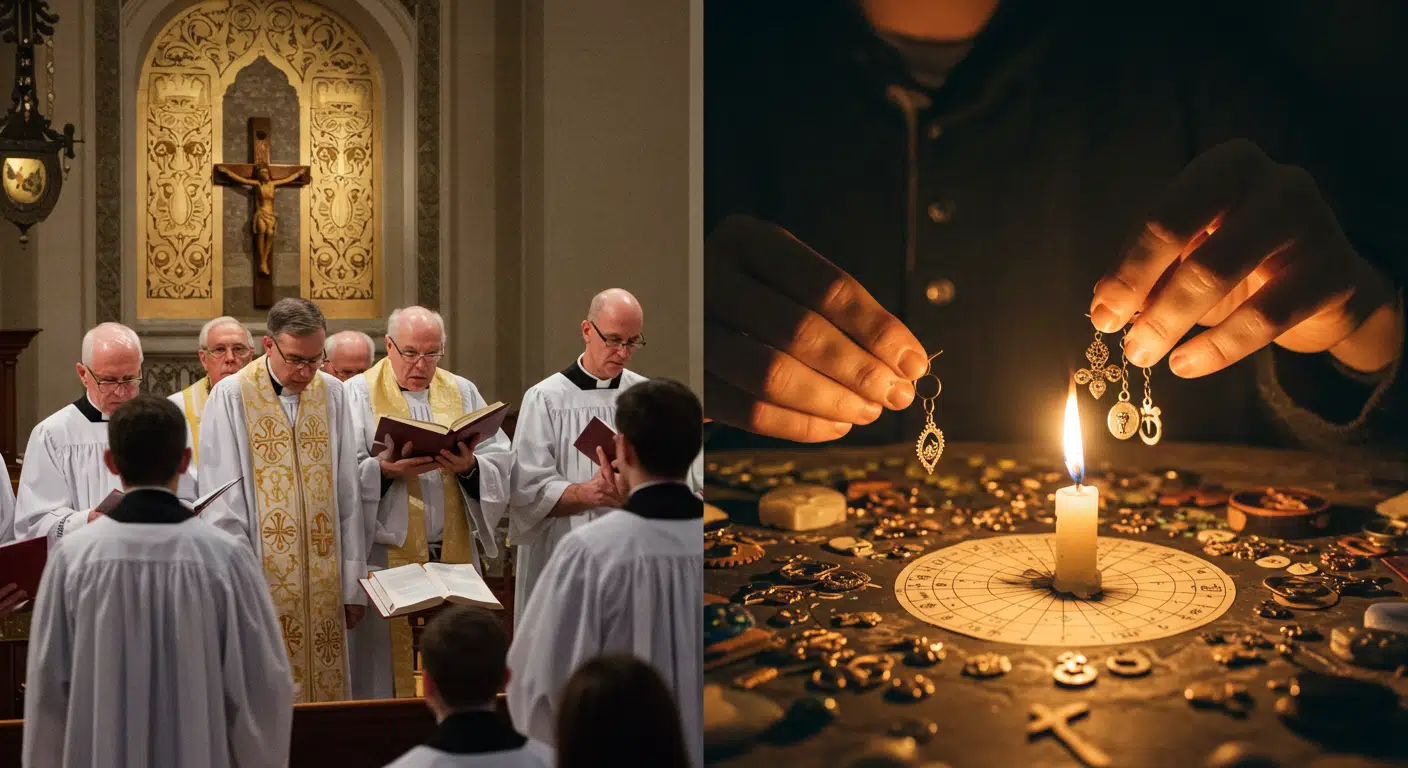
The relationship between religion and superstition is multifaceted, shaped by historical context, institutional authority, and psychological mechanisms. While there are clear points of overlap—such as the shared belief in supernatural causality—the notion that religion necessarily breeds superstition oversimplifies a complex interaction. Religion can function both as a source of superstitious beliefs and as a structure that actively suppresses them, depending on the doctrinal, cultural, and institutional setting.
Religious systems, particularly in their folk or informal expressions, often give rise to superstitious practices. These may emerge on the periphery of official doctrine, blending personal ritual with theological elements. For example, the belief that opening a Bible to a random verse will provide divine guidance is not a doctrinal necessity in most denominations but remains a widespread practice. Such rituals reflect a human desire to interpret uncertainty through symbolic means and often coexist with mainstream religious belief.
This overlap becomes especially evident in culturally syncretic environments. In many regions, especially where religion forms a dominant cultural framework, superstitions are absorbed into religious life. Folk Catholicism in Latin America and Southern Europe, for instance, integrates amulets, saint veneration, and ritualistic gestures that are not sanctioned by formal doctrine but persist in communal practice. Similarly, in Hindu traditions, astrological charts and planetary appeasement rituals are regularly integrated into temple worship and domestic religious life.
However, organized religion has also historically positioned itself in opposition to superstition. Institutional religion, particularly when centralized and doctrinally formalized, often seeks to distinguish “rational” or “true” belief from irrational excess. This is evident in historical writings that drew a clear line between religio and superstitio. Roman philosophers like Cicero regarded superstition as a corruption of religion, driven by fear and ignorance rather than moral order or philosophical reasoning. Early Christian theologians adopted this framing, distinguishing proper worship from idolatrous or magical practices, which they sought to suppress.
This suppression is also reflected in modern sociological data. Studies consistently show that active participation in organized religious institutions—such as regular attendance at services or adherence to formal theological teachings—correlates negatively with belief in superstitions. Religious authorities often view horoscopes, charms, and fortune-telling as incompatible with orthodox faith. For instance, the Catholic Church condemns astrology and divination, while Islamic jurisprudence classifies many superstitious practices as shirk (associationism), a serious theological error.
Nevertheless, individual spirituality—beliefs and practices detached from formal religious institutions—shows a higher tendency to incorporate superstitious thinking. People who identify as “spiritual but not religious” often combine elements of mysticism, astrology, energy healing, and symbolic rituals into a personalized belief system. In such contexts, the boundary between faith and superstition becomes blurred. This convergence reflects shared psychological mechanisms: both religion and superstition rely on pattern recognition, agency attribution, and symbolic reasoning to interpret ambiguous or emotionally charged events.
The psychological drivers behind both phenomena are well-documented. Humans are predisposed to seek meaning in patterns, especially under conditions of uncertainty or stress. Superstition often arises in response to specific concerns—passing an exam, securing a job, surviving illness—and employs rituals or talismans as perceived control mechanisms. Religion, while often addressing broader existential questions, also relies on symbolic acts—prayer, fasting, sacred texts—that fulfill similar cognitive and emotional functions. The difference lies in coherence and scope: religion typically offers a structured worldview and moral code, while superstition addresses discrete, often situational anxieties.
The debate over whether religion constitutes superstition itself is deeply influenced by philosophical and ideological perspectives. Critics such as Richard Dawkins and Jerry Coyne argue that religious belief is inherently superstitious because it is grounded in supernatural claims without empirical evidence. From this viewpoint, all faith-based systems qualify as superstition, differing only in social acceptability or historical influence. Defenders of religion, however, distinguish between superstition and faith on the basis of coherence, ethics, and theological reasoning. They argue that faith involves trust in a consistent metaphysical framework, often grounded in philosophical tradition and moral development, while superstition is fragmented, transactional, and fear-based.
Complicating the issue further is the use of the term “superstition” as a rhetorical tool. It is often employed to delegitimize beliefs outside the dominant cultural or religious norm. Early Christians were labeled as superstitious by Roman authorities for rejecting state-sanctioned gods. Later, Protestant reformers dismissed Catholic rituals such as relic veneration and indulgences as superstitious excess. Today, the term is frequently used to characterize traditional or indigenous beliefs as irrational, reinforcing power dynamics between religious orthodoxy and marginalized cultural practices.
In sum, religion does not inherently “breed” superstition, but the two can coexist, intersect, or conflict depending on context. In folk settings, religious belief can give rise to superstitious practices that operate alongside or beneath doctrinal frameworks. In institutional settings, religion often acts as a regulating force, suppressing or reinterpreting superstitious elements to align with theological orthodoxy. The persistence of both religion and superstition reflects deep-seated cognitive tendencies and social functions—tools for interpreting the unknown, managing anxiety, and constructing shared meaning.