
Discover the meaning behind the myths that still shape our world.

The Homunculus in Alchemy

Creating Life in a Bottle: The Legend of the Homunculus

Details

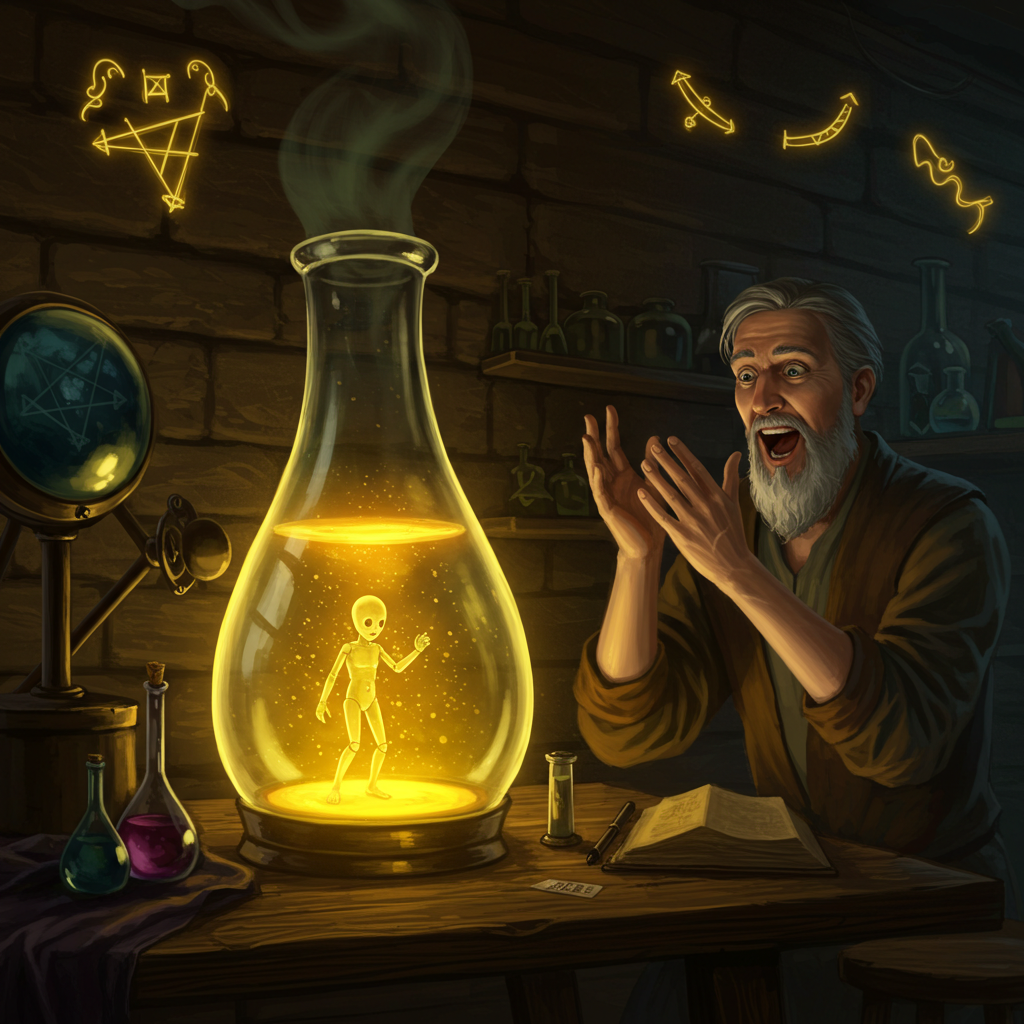
The homunculus was believed to be a miniature, fully-formed human created through alchemical processes rather than natural reproduction. These tiny beings, typically described as 6 to 12 inches tall, were thought to possess extraordinary intelligence, magical abilities, and hidden wisdom. Alchemists claimed that crafting a homunculus required a precise combination of ingredients—often including human blood, semen, and mandrake root—sealed within a glass vessel and incubated under specific astrological alignments. The homunculus represented a radical attempt to mimic divine creative powers and bypass the natural processes of human generation.

Historical Context

This concept emerged from the rich philosophical and mystical traditions of European and Middle Eastern alchemy. Paracelsus, the 16th-century Swiss physician and occultist, provided one of the most detailed descriptions of homunculus creation in his writings. He described sealing male reproductive material in a horse’s womb-like stomach and keeping it at a constant temperature for 40 days, after which a tiny, living human would allegedly form.

Earlier references appear in Arabian alchemical manuscripts, which described similar artificial beings created in flasks. In Jewish mysticism, the golem—a clay figure brought to life by sacred texts—reflected a parallel aspiration to animate the inanimate. The homunculus fused ideas from embryology, divine mimicry, and magical intelligence. Some sources claimed that these beings could reveal lost knowledge, guard treasure, or serve as psychic extensions of their creator.

Modern Relevance

Although belief in literal homunculi has vanished from scientific discourse, the idea remains influential in several domains. It inspired numerous early science fiction works about artificial humans and continues to appear in modern fantasy games, anime, and films. In neuroscience, the “sensory homunculus” refers to the distorted representation of the human body in the brain’s somatosensory cortex, based on nerve density. Philosophically, the homunculus problem in consciousness studies questions whether a “little man” inside the brain explains awareness, or merely duplicates the problem of perception.

The homunculus persists as a metaphor for humanity’s quest to master and replicate life—whether through synthetic biology, robotics, or AI.

Sources

  • Newman, W. R. (2004). Promethean Ambitions: Alchemy and the Quest to Perfect Nature. University of Chicago Press.
  •  Waite, A. E. (2011). The Hermetic and Alchemical Writings of Paracelsus. Forgotten Books.

Quick Facts

Historical Period

Artificial lifeform from alchemy

Practice Type

Created in sealed vessels with human material

Classification

Linked to divine mimicry and magical wisdom

Related Superstitions

Related Articles

Scroll to Top